
News Center
—— NEWS CENTER ——
The 24th Beijing China International Glass Exhibition Technical Lecture 2 (UV Ice Flower Glass Art Decoration)
Hangzhou Kewang Special Ink Co., Ltd. He Ping Part 2 The toughness and brittleness, beauty and ugliness of UV ice flowers The toughness and brittleness of UV ice flowers belong to the technical category, and the beauty and ugliness belong to the artistic category. UV technology and UV art are interrelated and inseparable. , the mission of UV engineers is to make decorative glass products reach the height of UV art and have artistic taste through the control of UV technology. The formation of perfect ice flower patterns depends on many factors, such as the production process of ice flower glass, light-curing equipment, ink composition and color, UV light intensity, irradiation time, oxygen barrier effect, temperature during UV light irradiation, etc. 1) UV ice glass production process flow Glass cleaning and drying → Mixing of additives and ink → Screen printing UV ice flower ink → Formation and light curing of UV ice flower → Cleaning and drying before ice flower glass plating → Vacuum coating → Laminated back paint → IR drying → Ice flower glass finished product. 2) Main production equipment of ice flower glass The most important equipment for producing UV ice flower glass is a special UV light curing machine, and other equipment such as glass cleaning and hot air drying equipment, screen printing machines, short and medium wave infrared drying tunnels, vacuum coating machines, paint coating and drying equipment. 3) Structural features of ice flower light-curing machine UV ice flower light-curing machine is the key equipment for the production of ice flower glass. Although the equipment also uses high-pressure mercury lamps as the light source, its structure is different from ordinary light-curing machines. The characteristics are as follows: 1 From the appearance, the UV ice flower light-curing machine is much longer than the ordinary light-curing machine. Generally, for a three-lamp machine, the lighting area is 3-4 meters long and the total length is 6-8 meters . The length of an ordinary three-lamp UV curing machine is generally only 2.5-3.5 meters long, as shown in Figure 7 .
 Figure 7 Light distribution diagram of UV ice flower light-fixing machine Figure 8 UV ice flower light fixing machine lamp adjustment mechanism 2 Each lamp has a different function and the lamp distance is adjustable. The first two lamps are used to form ice flowers, and the distance between the two lamps is one meter. The distance between the first and second lamps is generally 50-60 cm . The last lamp is used to solidify the ink, and the distance between the lamps is 15 cm . Usually a 70-80 W/cm high-pressure mercury lamp is used , see Figure 8. 3 The temperature control requirements are high and there are many fans. The four-light machine has a total of ten fans, as shown in Figure 9. Four fans exhaust air and six fans inlet. Regardless of spring, summer, autumn or winter, the temperature inside the light box is required to be controlled within the temperature range of 35-55 °C . 4 Lampshade wide. The lampshade is a two-piece, astigmatism type, wide-width structure, so that the light illumination area is large and the intensity is uniform, see Figure 10. 5 Adjustable ventilation reflectors are installed under the mesh belt. It can not only control ventilation and temperature, but also adjust the uniformity of light, see Figure 11. Standard four-lamp UV ice-fixing machine, the width of the mesh belt/roller is 2 meters, the length of the light-emitting area of the lamp is 1.95 meters, the first three lamps are 12 kW/unit, the last lamp is 16 kW/unit, the total lamp power is 55 kW, the machine The width is 2.2 meters, the length of the light box is 5 meters, and the total length is 7-8 meters . The first three lights produce ice flowers, and the last one is used to solidify ink.
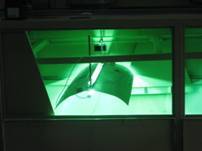
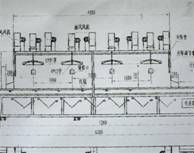 Figure 9 Fan distribution diagram of Binghua light-fixing machine Figure 10 Diffuse wide UV lampshade Figure 11 Adjustable reflector of ice flower light-setting machine 4) Energy-saving UV ice flower light-setting machine does not require strong ultraviolet light to form UV ice flowers. When the light is too strong ( ﹥250mj/cm2) , the ice flowers will be cured before the ink is formed. . As can be seen from the structure diagram of the UV ice flower light curing machine in Figure 11, the distance between the UV lamp tube and the glass is generally 50-70 cm, which is much higher than the lamp distance of the ordinary UV curing machine (10-15 cm). Although increasing the lamp distance can expand the light irradiation range and reduce the light intensity on the glass, the disadvantage is a waste of energy. A standard two-meter-wide, four-lamp UV ice flower light curing machine has a power of about 55-60 kilowatts/ It not only consumes a lot of energy but is also difficult to dissipate heat. Especially when the temperature is above 35 degrees in summer, the temperature inside the chassis is even more difficult to control. How can we reduce the power of the ice flower light curing machine? First of all, it is necessary to understand the functions of each section of the Binghua light-curing machine before it is possible to design an energy-saving machine. The ideal ice flower light-curing machine should be divided into three areas: 1) The ice flower formation area requires appropriate and uniform light intensity (200-250mj /cm2 ) and a larger light range. If you want uniform illumination, you can increase the number of UV lamps and lower the lamp height to about 20 cm. Within a 4-5 meter long range, you can evenly arrange several 195 cm long high-pressure mercury lamps. The light intensity can be controlled at 20-30 watts/cm, the luminous wavelength is the same as that of ordinary UV lamps; 2) The fission zone, also known as the dark light zone, does not require UV irradiation and is about 1-2 meters long. The function of the fission zone is to allow sufficient time for the ice flower coating to fission; 3) The ice flower solidification area, 1-2 UV high-intensity UV lamps (80-120 watts/cm), about 1 meter in length, allows the ice flower ink to undergo fission well Dry as quickly as possible. ‖Solidization zone︱Fission zone︱Ice flower formation zone‖ 0.5-1m 1-2m 4-5m _ Figure 12 Functional diagram of the energy-saving UV ice flower light-curing machine. For a light-curing machine with the same power, the new machine is much more efficient than an ordinary light-curing machine, and the ventilation and cooling effect will be much better. Comparing Figure 11 and Figure 12, it can be seen that the difference between the energy-saving UV ice flower light-curing machine and the ordinary ice flower light-curing machine lies in the ice flower formation area. The former uses a 30W/cm low-intensity UV lamp. If the same power of UV ice flower is used, The light curing machine can arrange several more UV lamp tubes to increase the length of the light-emitting area, which can greatly improve production efficiency. 5) Cleaning and drying of glass. There is a small amount of oil, dust, fingerprints and other dirt on the surface of the newly purchased glass. It must be cleaned and dried with water before UV ice flower ink can be printed. Otherwise, the adhesion fastness and water resistance of the ice flower ink will be affected. wait. 6) Factors influencing the formation and curing of UV ice flowers 1. Ink color and transparency The depth of the color not only affects the curing of UV ice flower ink, but also directly affects the formation of the ice flower pattern. The darker the color, the lower the transparency, the smaller the ultraviolet penetration rate, and the slower the ice flower formation and ink layer solidification. Colorless and transparent ice flower ink produces ice flowers the fastest and dries quickly. 2 UV light irradiation intensity Generally, the stronger the light, the faster the curing speed of UV ink. However, the formation of UV ice flowers does not require too strong light. If the light is too strong or too weak, ice flowers will not appear. With a certain thickness and color of ice flower ink, the UV light energy required to form ice flowers is certain. If the light is too strong, the ink will solidify before the ice flowers form; if the light is too weak, the ice flowers can form slowly, but the surface will be difficult to dry. Generally, it is more appropriate to control the UV light intensity at 200-250mj/cm2. At present, the lamp power of UV ice flower equipment commonly used on the market is 60-80 watts/cm. The front 2-3 mercury lamps play the role of producing ice flowers. In order to reduce the light intensity, the distance between the lamp tube and the mesh belt can be controlled at 50-50 watts/cm. Within the range of 60 cm, the distance between the last lamp and the lamp is usually 10-20 cm. 3 UV light exposure time Ink with the same thickness requires a certain amount of light energy to form a UV ice flower pattern. E (light energy) = J (light intensity) × S (light time). It can be adjusted by changing the light intensity J or changing the light time S. The ice flower patterns are big or small, tough or brittle, or beautiful or ugly. Increase the lamp distance between the two front lights of the ice flower light-curing machine, the intensity of the ultraviolet light will naturally weaken, and the curing speed of the ink will slow down. At this time, the inhibitory effect of oxygen will not be affected, and the time to form ice flower cracks will be will become longer, the cracks will have the opportunity to extend longer and become larger, and the larger the ice flowers will be after solidification. So if you want to produce ice glass with large patterns, you should increase the lamp distance. Lowering the mesh and increasing the thickness of the ice flower ink layer can also make the ice flower pattern larger. The size of the ice flower is also directly related to the ink formula. 4Oxygen resistance effect The oxygen barrier effect is a phenomenon in which UV ink is hindered by oxygen dissolved in the air when it is cured in the air, resulting in a slower drying speed of the ink. Insufficient surface curing of UV ink, low surface hardness, and even stickiness are caused by the oxygen barrier effect. In the air, the oxygen barrier effect hinders the curing of free radical UV ink all the time. This is a defect that has always troubled people. Everything is divided into two, and the problem cannot be taken to death. We took advantage of this defect to develop UV ice flower ink, turning harm into benefit and making it serve mankind. During the formation and light curing of ice flowers, the influence of oxygen in the air is much greater than that of ordinary UV inks. The formation of ice flower patterns is the result of the competition and balance between the main reaction of light curing and the side reaction of oxygen inhibition. If there is no side reaction of polymerization inhibition without oxygen, or even if the speed of this side reaction is not fast enough, the ice flower pattern will not be formed, or the pattern formed will not be beautiful, but ugly. The more oxygen dissolved in the ink, the greater the oxygen barrier effect and the slower the ink will cure. The printed glass is left in the air for different times, and the dissolved oxygen in the ice flower ink is also different. The longer it is left, the more oxygen is dissolved in the ink, and the slower the ice flowers are produced. Therefore, the glass with ice flower ink printed must be illuminated as soon as possible and cannot be left for too long. The responsibility of UV technicians is to create various favorable conditions to make the photochemical reaction proceed in the direction of beautiful ice flowers. We can not only control the size of the ice flower pattern, but also adjust the density of the ice silk to meet the requirements of artistic design through technical control. 5 Temperature during UV light irradiation Under air-isolated conditions, the light-curing reaction is usually not affected by temperature or has little effect. However, when the light-curing reaction is carried out in the air, the temperature is different, and the dissolution rate of oxygen in the UV ice flower layer is also different. The higher the temperature, the faster the dissolution rate of oxygen, the more oxygen in the ice flower ink layer, and the greater the oxygen resistance effect; the lower the temperature, the weaker the oxygen resistance and the faster the curing speed. Temperature affects the formation of UV ice flowers by changing the strength of the oxygen resistance effect. Therefore, during the production process of ice flower glass, we should try to prevent the temperature fluctuations in the light-curing machine from being too large, otherwise the ice flowers produced will be larger and smaller at times. , sometimes beautiful and sometimes ugly, product quality is unstable, this is not what we want to happen. The same UV ice flower ink, the same ice flower light-curing machine, the same production process, and the same operators, but the ice flower products produced in winter and summer will be different. This is due to changes in external temperature that lead to light curing conditions. changes. 7) Brittleness and Toughness of UV Ice Flowers Although the UV ice flower pattern is beautiful and suitable for decoration of glass products, its surface is very hard. When the glass is cut, the edges are easily brittle and fall off, and its water resistance is poor, which seriously affects its use in decorative glass. For applications, see Figure 13. The reason why the ice flower solidified layer is hard and brittle is determined by its formation mechanism. From the formation mechanism of UV ice flowers, we can know that the ice flower pattern is caused by the strong contraction of the multifunctional photosensitive resin in UV ink during the illumination process, and it looks like countless ice flowers gathered together. The greater the shrinkage rate of the ink layer relative to the glass, the more obvious the ice flowers will be, the greater the brittleness, the worse the fastness, and the lower the adhesion. On the contrary, if the shrinkage rate of the film layer is very small, the adhesion fastness may be very good, but it will not It can form beautiful ice flower patterns, which is a contradiction. It is impossible for UV ink not to shrink when exposed to light. Besides, how can ice flowers be formed if it does not shrink? We cannot change the fact that ice flowers shrink to form ice flowers. To resolve this contradiction, we must not only make the ice flowers shrink beautifully, but also make the cured film tough and not brittle. On the surface, this seems to be an irreconcilable contradiction. 8) Dual-curing UV glass ice flower ink technology is constantly improving and will not stagnate. As long as it is a beautiful thing and has huge market demand, no matter how difficult the technical obstacles are, it cannot stop people from exploring the unknown world. Generally speaking, the level of people's understanding of a certain technical problem is the same as the level of solving the problem. As long as there are new ideas, there will be new breakthroughs in technology. At the end of 2011, Kewang Company used dual-curing technology and took the lead in developing dual-curing glass ice flower ink that can be both light-cured and heat-cured. Light curing shrinks the ink layer to form a beautiful UV ice flower pattern. Heat treatment further solidifies the thermosetting component in the ink, releases the stress in the cured ink layer, and chemically reacts with the active groups on the glass surface, which not only improves the effect on the glass. Adhesion fastness and water resistance are improved at the same time, see Figure 14.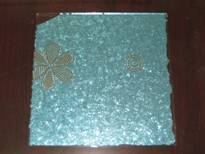
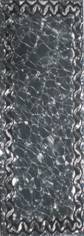
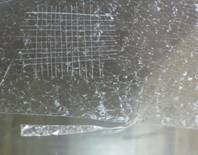 Figure 13 UV glass ice flowers are hard and brittle Figure 14 Dual-curing UV toughness ice flower 9) UV ice flower ink colors Kewang Company currently supplies more than a dozen kinds of ice flower inks to the market, among which the six most commonly used colors are shown in Table 2. Table 2 Commonly used UV glass ice flower ink color samples
Yan color | Colorless and transparent | champagne | Pink | Claret | Lilac | Transparent yellow |
type Number | UV-GI-880 N | UV-GI-880 YR | UV-GI-880 R | UV-GI-880 R352 | UV-GI-880 Z237 | UV-GI-880 Y |
color Card
|
|
|
|
|
|
|





10) Water resistance of UV ice flowers There are two ways to improve the water resistance of UV glass ice flowers. One is to add waterproofing additives to the ink, and the other is to first print a layer of transparent base oil on the glass surface. Both methods have their own advantages and disadvantages. Addition of waterproof additive - Before printing UV ice flower ink, you need to add 21# waterproof additive. The amount added is generally about 1-2% of the ink weight. The amount of 21# has a certain impact on the size of the ice flower and the amount of ice silk. After adding additives, the ink should be used up as soon as possible and should not be left for too long to avoid affecting the performance of the ink. Adding 21# additive can not only improve the adhesion fastness of the cured film to the glass, but also improve the water resistance of the ice flower ink. 21# is a photosensitive silicone additive. It is very active and can easily react chemically with reactive groups such as ink and moisture in the air. Therefore, it cannot be stored for a long time. It is recommended to prepare it for immediate use and endless ice flower ink. , it is recommended to store it in the refrigerator. UV ice flower transparent base oil - In order to improve the water resistance of ice flower glass products, Kewang Company specially provides users with a two-component thermosetting glass varnish. After the varnish is mixed with the curing agent, it can be left at room temperature for 6-12 hours to naturally To dry, you can also bake and dry at 120-150 ℃ /15-20 minutes. Before printing glass ice flower ink, first print a layer of transparent varnish on the glass surface. This layer of varnish not only has good adhesion to the glass and good toughness, but also has excellent water resistance, acid and alkali resistance. 11) The ice flower glass after vacuum coating with UV ice flower back paint needs to be coated with a layer of protective back paint. Commonly used protective back paints include two-component epoxy, polyurethane and acrylic resin. There are also single-component ones such as organic Silicon, etc. When choosing the back paint, you must adhere to the following principles: 1 ) The less corrosive the back paint is to the UV ice crystal cured layer, the better. Because no matter what type of back paint is applied, the organic solvents in it will corrode the ice flower coating, which will damage the adhesion of the ice flower coating to the glass, and even cause the entire piece to fall off when peeled off with tape. In order to reduce the impact of the back paint on the ice flower ink layer, the applied back paint should be dried as soon as possible to allow the solvent to evaporate quickly. 2 ) The curing temperature of the back paint cannot be too high. After the ice flower ink is fully cured, the cross-linking density is very high, and the shrinkage rate of the cured film is very small. If the baking temperature of the back paint is too high, the shrinkage rates of the glass and the ice flower ink layer will be inconsistent, and the adhesion will not be good. 3 ) The lower the shrinkage rate of the cured film, the better. 12) Technical indicators of glass UV ice flowers. The technical indicators of UV ice flowers include ink and cured film. The ink indicators include viscosity, printability, light curing speed, etc. The indicators of ice flower cured film include: 1) Transparency: Cured glass ice flowers , viewed against the light or viewed from the reverse side with a mirrored metal plate, clear, transparent, and no turbidity Turbidity phenomenon, otherwise it will affect the three-dimensional effect of the ice glass after coating. 2) Adhesion: 100% (frame/tape method). There is no brittleness on the edges and no peeling off at the intersection. 3 ) Tough Properties: Use a single-sided blade to scrape the cured film against the glass. It will be in the shape of a rubber strip and no large pieces will fall off. 4 ) Ice flower size: Based on the average length of the sides enclosed by ice flower cracks, larger than 1 cm is considered large ice flower, 0.5-1 cm is considered medium ice flower, and less than 0.5 cm is considered small ice flower. Different sizes of ice flower patterns are suitable for different products. 5) Ice silk density: The density of ice silk directly determines the three-dimensional effect of ice flower glass. The density of ice silk is high, the refraction effect is good, the three-dimensional effect is strong, the density is low, the transparency is good, and the three-dimensional effect is poor. 6 ) Surface hardness: 3-4H 7 ) Water resistance: After UV-cured ice crystal glass is soaked in tap water at room temperature for 12 hours, it is wiped dry with paper towels and tested. The adhesion is 100%. Surface hardness is above 3H. 8 ) Solvent resistance: The more fully the ice flower ink layer is cured, the higher the cross-linking density, the better the solvent resistance, and it is less likely to cause quality problems when applying the back paint.
please leave us a message